The TRIP MAP™ Industry Evaluation Framework = TRIP™ Technology Readiness Inflection Points
vs. MAP™ Market Adoption Profile
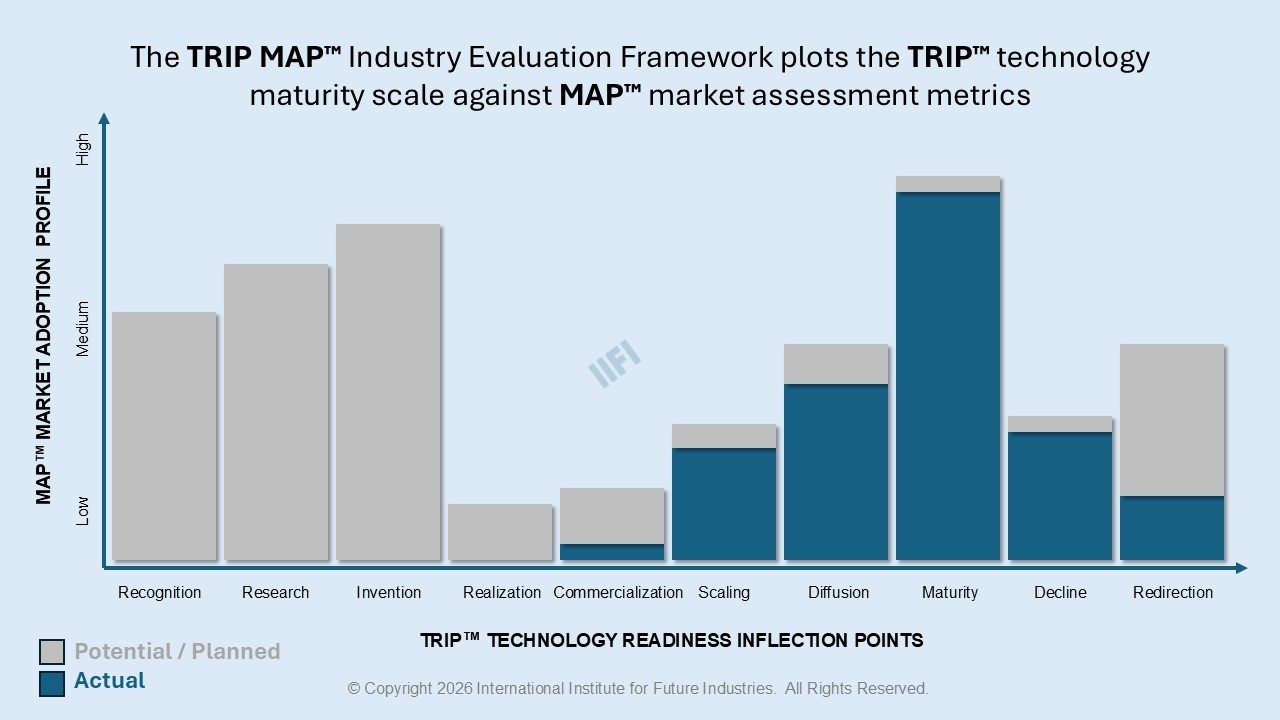
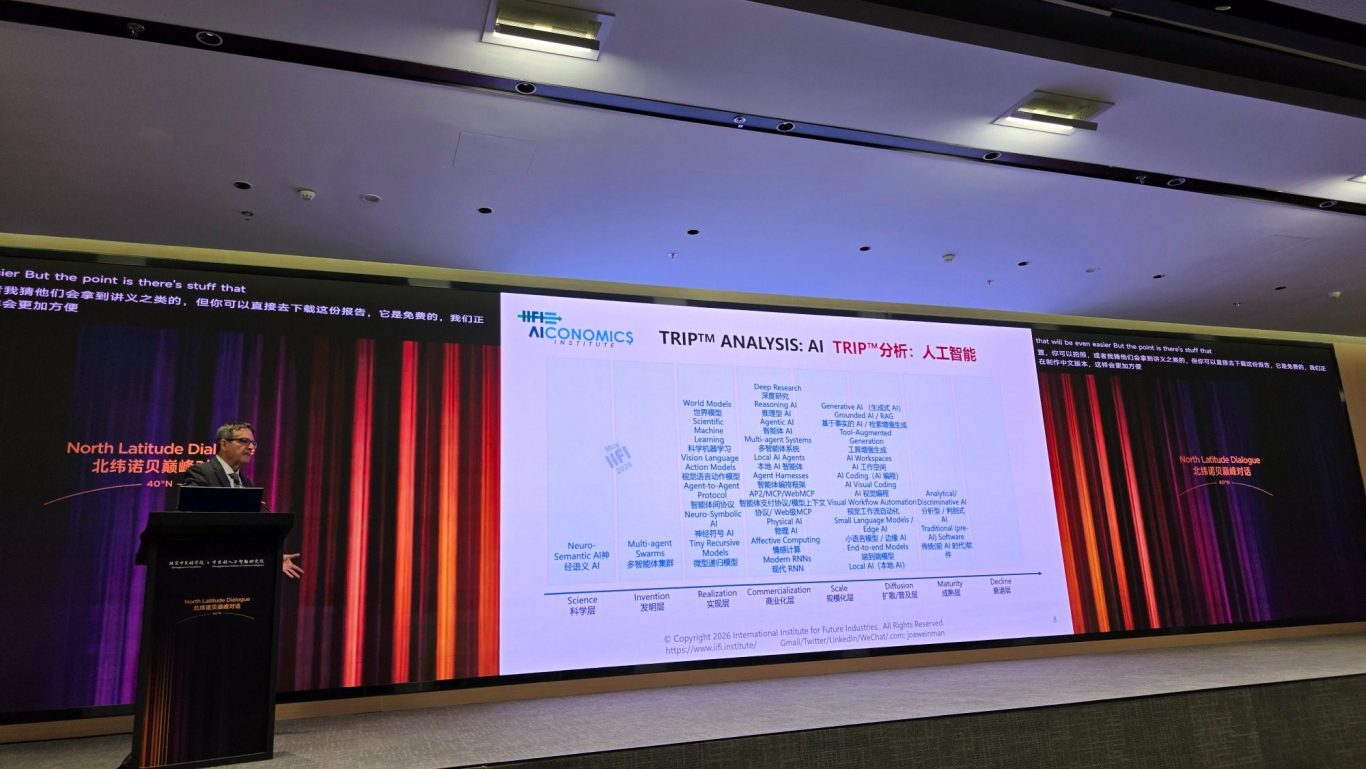
The TRIP MAP™ industry evaluation framework and consulting/advisory services plot the TRIP™ Technology Readiness Inflection Points scale against the MAP™ Market Adoption Profile market assessment metrics. This two-dimensional framework helps evaluate the maturity and economic potential of technology-based products and services throughout their lifecycle, with critical diagnostic utility for business planning and competitive analysis including R&D allocation; corporate strategy, organization, and talent management; and venture capital, investing, and M&A analysis. Together, they provide a mechanism to evaluate the maturity and market adoption (historical, current, and potential/planned) of technology-based products and services. TRIP MAP™ unifies and improves upon frameworks such as Disruptive Innovation and the Technology Adoption Life-Cycle model.
The TRIP™ scale models 10 phases: 1) recognition; 2) research; 3) invention; 4) realization; 5) commercialization; 6) scaling; 7) diffusion; 8) maturity; 9) decline; 10) redirection. Here's an overview of the framework. Here's a case study example: the "sticky notes" industry.
THe MAP™ scale addresses the dynamically changing profile, i.e., size and structure, of a technology, company, or industry, showing how a promising technology can potentially accelerate in interest, or perhaps have no immediate application. This can be qualitative (e.g., high, medium, low), quantitative (e.g., quarterly unit volume, profitability, revenues, or online search mentions), or structural (e.g., how market segments evolve).
It forms the basis of IIFI's Disruptive Tech innovation strategy consulting and industry analysis reports.
We offer:
- Technology Strategy & Advisory Services
- Keynote Speaking & Executive Briefings
- Corporate Training & Workshops
- Case Studies and Research Reports
The Framework
1. Recognition (of Opportunity)
In commercial innovation, often the first step is recognition of a customer issue or job to be done, a market need, an emerging trend, a competitor weakness, or a business opportunity.
For example, nearly a century ago, Chester Carlson identified the unsuitability of traditional photography in document reproduction: it was slow, messy, involved the use of wet chemicals, etc.
The TRIP™ Framework
The TRIP framework consists of 10 stages. Each stage has different characteristics and exit criteria. In the real world, the exact order may vary. For example, an invention may precede formalization of a market need, or the realization of an invention may actually lead to a different market opportunity.
2. Research (Science)
In tech-enabled innovation, pure and applied research is typically necessary. This includes observation, experimentation, analysis, and theorization of physical, chemical, biological, mathematical, or computational phenomena.
For example, from 1934-1937, Carlson explored photoconductivity--pursuing an insight that light could modulate an electric charge to form an image.
3. Invention
This stage includes ideation and conception of a novel, non-obvious process, system, article of manufacture, or composition of matter, as well as anticipation of variations of embodiments. This IP may be protected via a patent or trade secret.
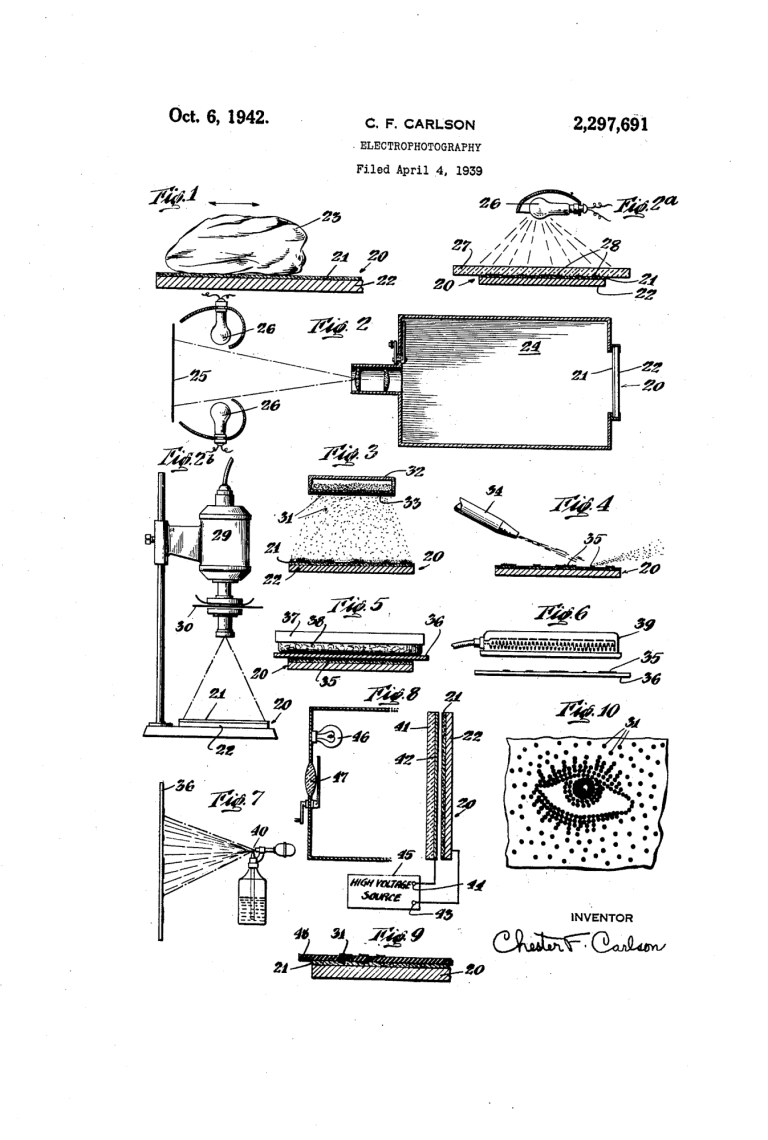
From 1937-1938, Carlson created provisional designs for a theoretical photocopying system, and filed a patent application in 1939.
4. Realization (and Refinement)
The next step in the innovation process is reduction to practice: creation of a working physical model or proof of concept. Typically, early prototypes will be refined via engineering, optimization, further research, testing, and trials.
In 1938, Carlson produced the first xerographic image ever, proving that the theoretical physics and inventive design could actually work. The next two decades were spent refining and optimizing the prototype to create a usable automated machine.
5. Commercialization
Formulation and iteration/pivoting of a business model, profit formula, business plan, and customer value propositions. Acquisition and deployment of financial, human and physical resources needed to launch.
In 1959, the Xerox 914 copier was introduced, together with a business model that eschewed ownership in favor of a leasing model together with metered usage.
6. Scaling
After launch, scaling becomes the next challenging step, whether it is hiring the right individuals, standardizing workflows, creating production and service delivery infrastructure, or mastering supply chains and distribution channels.
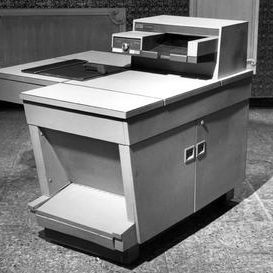
From 1960-1970, the explosion in photocopier usage meant that Xerox needed to rethink and invest in direct consultative sales and service channels, and to create supply chains for toner and paper.
7. Diffusion
Business growth goes hand in hand with customer adoption. But moving beyond early adopters to the mass market, i.e., "crossing the chasm," can be challenging. Virality and network effects and support for behavior change can facilitate adoption.
In one decade, the number of total copies printed grew nearly a thousand-fold. Convenience and low-cost meant that copying changed from an annoying, smelly process to a default mechanism for communication and collaboration--an early form of today's interoffice email.
8. Maturity
After months or years of growth, the new innovation becomes widely adopted. Whether measured by unit sales, revenue, or active use, growth flattens. New entrants increase industry rivalry and margins compress. Products, interfaces, and interoperability become standardized, capabilities become modularized, features reach parity.
In 1970, IBM introduced the Copier I, and in 1975, Kodak introduced the Ektaprint 100. Increased competition led to multiple sustaining innovations, such as two-sided printing.
9. Decline
There is contraction in unit volume and revenue, due to saturation, shifting customer tastes and needs, substitution, and emerging disruptive technologies.
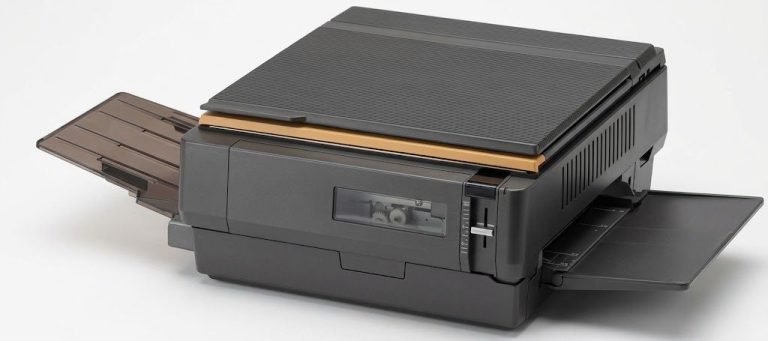
In 1975, the FTC used anti-trust laws to mandate that Xerox non-exclusively license its patents. In classic low-end disruptive innovation fashion, Canon and Ricoh introduced "good enough" desktop copiers at low price-points.
10. Redirection
At any stage, but certainly after or during a period of decline, it's necessary to rethink strategy. Redirection can include:
- Retirement: end-of-life termination
- Repression: suppression or throttling of supply
- Reset: industry structure transformation
- Rehoming: divestiture or spin-offs
- Revival: capitalizing on nostalgia or authenticity
- Remixing: merging legacy models with new tech
- Re-ecosysteming: expanding into adjacent offers
- Relegation: to a niche or subsegment
- Renovation: incremental innovation
- Rebranding: altering perception, value, or category
- Repurposing: finding a new use
- Relocation: migration or expansion to new geographies
- Retargeting: to a new demographic
In the example of the 914, centralized floor-standing copiers became reinvented as multi-function print centers, production digital presses, and networked document management systems.